Ethereum-Backed Loans
Borrow US dollars against Ether you already hold. Your ETH is posted as collateral, you receive the loan, and your position stays intact for the term.
What you can borrow against Ethereum
| Maximum starting loan-to-value (LTV) | 65% |
|---|---|
| Margin call at | 75% LTV |
| Liquidation at | 82% LTV |
| Interest rate (annual) | 12.5%, paid monthly |
| Origination fee | 1% of the loan amount, deducted at drawdown |
| Minimum loan | $5,000 |
| Maximum loan | No fixed upper limit. Larger facilities are reviewed individually |
| Terms available | 1 to 48 months |
| Loan currency | US dollars or USDC |
Why the Ethereum ceiling sits below Bitcoin’s
Because the ceilings are set by how the asset behaves in a forced sale, not by any view on which asset is better.
Bitcoin has the deeper market of the two, so a large position can be sold into it with less slippage. Ether’s market is deep by any normal standard and thinner than Bitcoin’s, so the buffer between the starting ratio and the margin call is set wider.
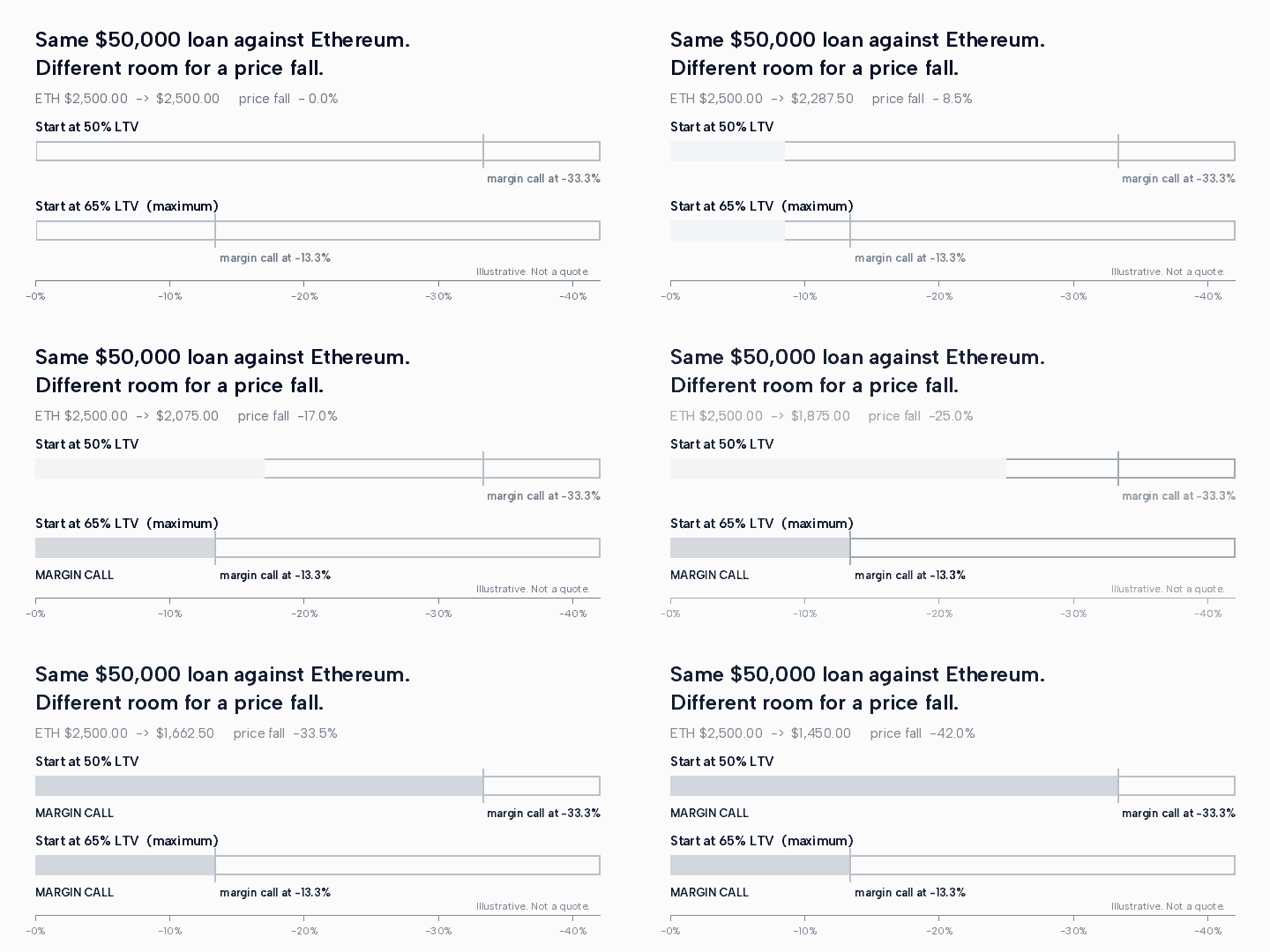
The practical effect is small and worth knowing. At its maximum, an Ethereum loan absorbs a 13.3% fall before a margin call. A Bitcoin loan at its maximum absorbs 12.5%. The difference is not the headline ceiling; it is what the ceiling is protecting against.
A worked example
Illustrative. A round $2,500 Ether price is used for clarity, not as a market quote.
You want $50,000.
At the 65% maximum you post $76,923 of ETH, which is 30.7692 ETH. Your margin call arrives at $2,166.67, a fall of 13.3%.
At 50% you post 40 ETH. Your margin call moves down to $1,666.67, a fall of 33.3%.
The second loan costs 30% more collateral and buys you two and a half times the room. Test your own ratio in the calculator.
How an Ethereum loan runs
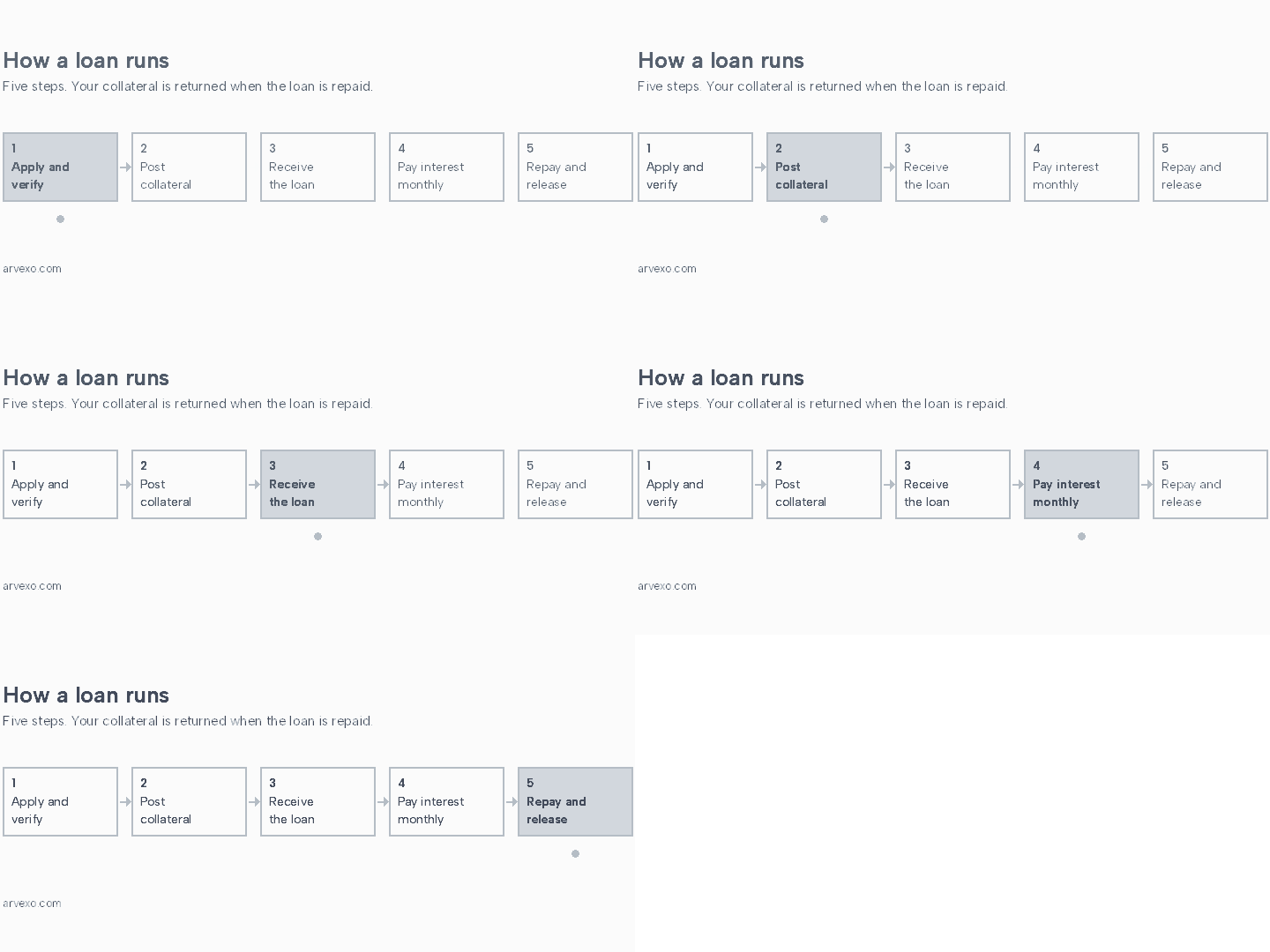
Verification first. Identity checks apply. No credit check is involved.
Transfer your ETH to the custody arrangement below. Send on the correct network; a transfer on the wrong network can be unrecoverable, and that is true of every platform, not just this one.
Take the loan in US dollars or USDC. The 1% origination fee is deducted when it pays out.
Interest monthly, principal at maturity. How crypto-backed loans work walks through the full cost of a loan including the fee.
Repay and your ETH comes back, the same amount you posted.
Custody
Collateral sits with institutional custodians, Ledger and Cobo Custody, in segregated wallets, and is not lent out for the duration of your loan.
Ask any lender you are comparing the same question, and ask for the clause rather than the assurance. “We don’t currently do that” and “we are contractually prohibited from doing that” are very different answers. How Arvexo holds collateral has the detail.
The risk
Ether can fall hard and fast. In May 2022 the European Securities and Markets Authority recorded that Bitcoin and Ether both fell more than 30% inside a single week. An Ethereum loan opened at the maximum ratio absorbs 13.3% before the margin call and 20.7% before liquidation. That week would have gone through both.
If your collateral falls far enough we ask for more collateral or partial repayment. If it keeps falling, the collateral is sold.
Collateral can fall in value and be sold. This page is for general informational purposes only and does not constitute financial, investment, legal, or tax advice.
Questions about Ethereum loans
- Can I lose my ETH?
- Yes, if its value falls far enough that the collateral has to be sold to repay the loan. That is the central risk of any secured borrowing and it is why the starting ratio you choose matters more than the rate.
- What if Ether rises while my loan is open?
- Your loan-to-value ratio falls and your position moves further from a margin call. The collateral is still yours, so the gain is yours. You can also usually withdraw the surplus collateral or borrow more against it, subject to the ratio.
- What happens if the lender goes bankrupt?
- Collateral held with a third-party custodian in segregated wallets sits on a different footing from collateral pooled on a lender’s own balance sheet. In the 2022 failures, the terms of use decided who owned the digital assets, and a US bankruptcy court found that deposits in one platform’s Earn accounts were property of the bankruptcy estate rather than of the account holders. Read the title clause of any agreement before you sign it. How Arvexo holds collateral explains what to look for.
- Is there a minimum?
- $5,000, with no fixed maximum. Larger facilities are reviewed case by case.
Arvexo is not available in every country, and residents of some US states and Canadian provinces can visit the site but cannot use the service. Check availability before you apply.
Also available: Bitcoin-backed loans · Solana-backed loans · All crypto-backed loans
Collateral can fall in value and be sold. This page is for general informational purposes only and does not constitute financial, investment, legal, or tax advice.