Bitcoin-Backed Loans
Borrow US dollars against Bitcoin you already hold. Your BTC is posted as collateral, you receive the loan, and you keep your position for as long as the loan runs.
What you can borrow against Bitcoin
| Maximum starting loan-to-value (LTV) | 70% |
|---|---|
| Margin call at | 80% LTV |
| Liquidation at | 85% LTV |
| Interest rate (annual) | 12.5%, paid monthly |
| Origination fee | 1% of the loan amount, deducted at drawdown |
| Minimum loan | $5,000 |
| Maximum loan | No fixed upper limit. Larger facilities are reviewed individually |
| Terms available | 1 to 48 months |
| Loan currency | US dollars or USDC |
Bitcoin carries the highest LTV ceiling of any collateral Arvexo accepts. That is a liquidity judgement rather than a view on the asset: Bitcoin has the deepest market of the five, so it can be sold with less slippage if it ever has to be.
A worked example
Illustrative. A round $100,000 Bitcoin price is used for clarity; it is not a market quote.
You hold 1 BTC and want $50,000.
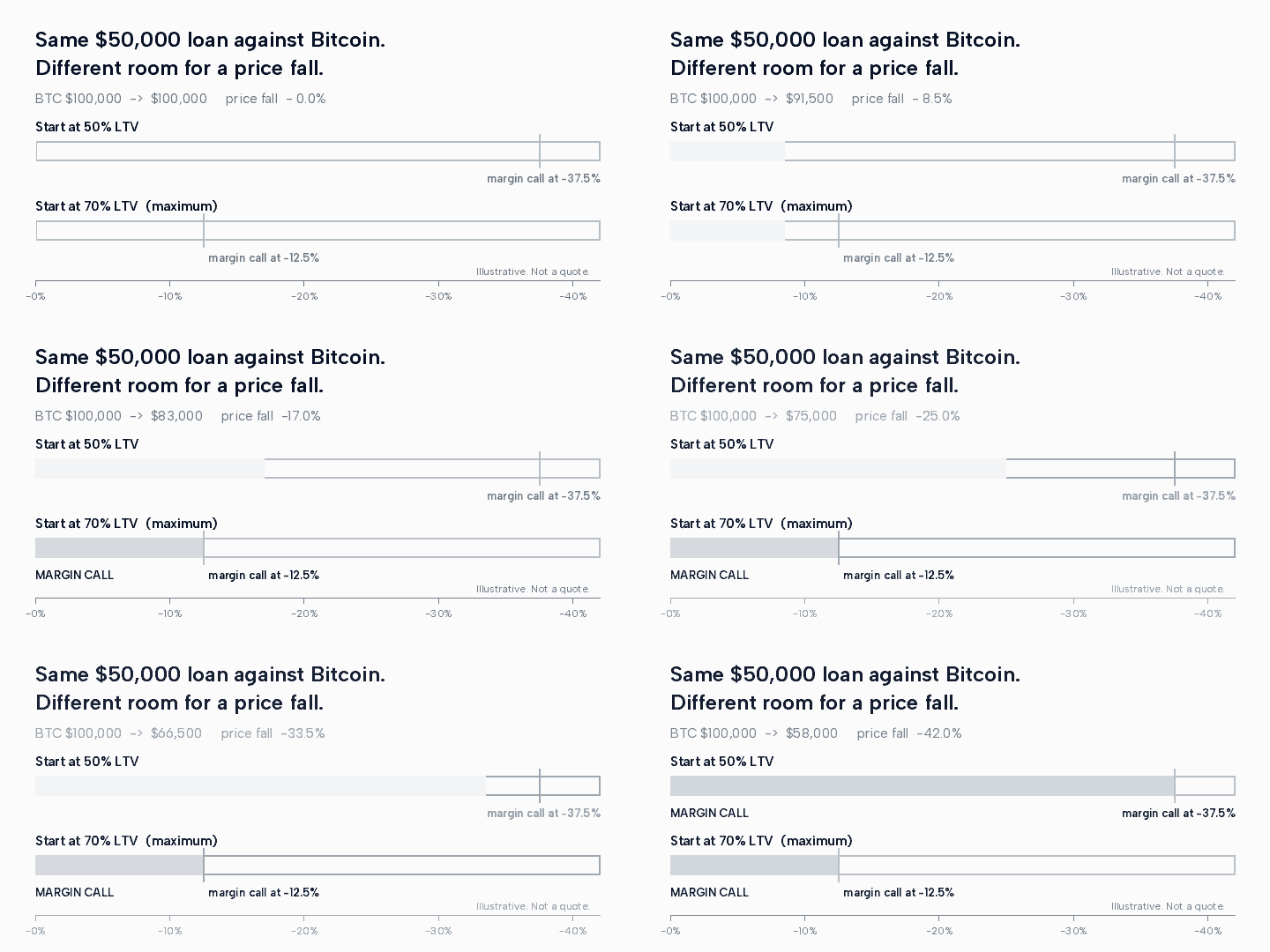
At a 50% starting LTV you post the full coin as collateral. Your margin-call price is $62,500, so Bitcoin would have to fall 37.5% before you hear from us.
At a 70% starting LTV you post 0.7143 BTC and keep the rest. Your margin-call price is $87,500, a fall of 12.5%.
Same loan, same day, same asset. The second option ties up about 29% less collateral and leaves you with roughly a third of the safety margin. Neither is the right answer for everyone, which is why the choice is yours rather than ours.
The 1% origination fee is deducted from the loan when it pays out, so $49,500 of the $50,000 reaches your account. Your loan balance, and your LTV, are still calculated on $50,000.
Work through your own numbers in the calculator.
How it works
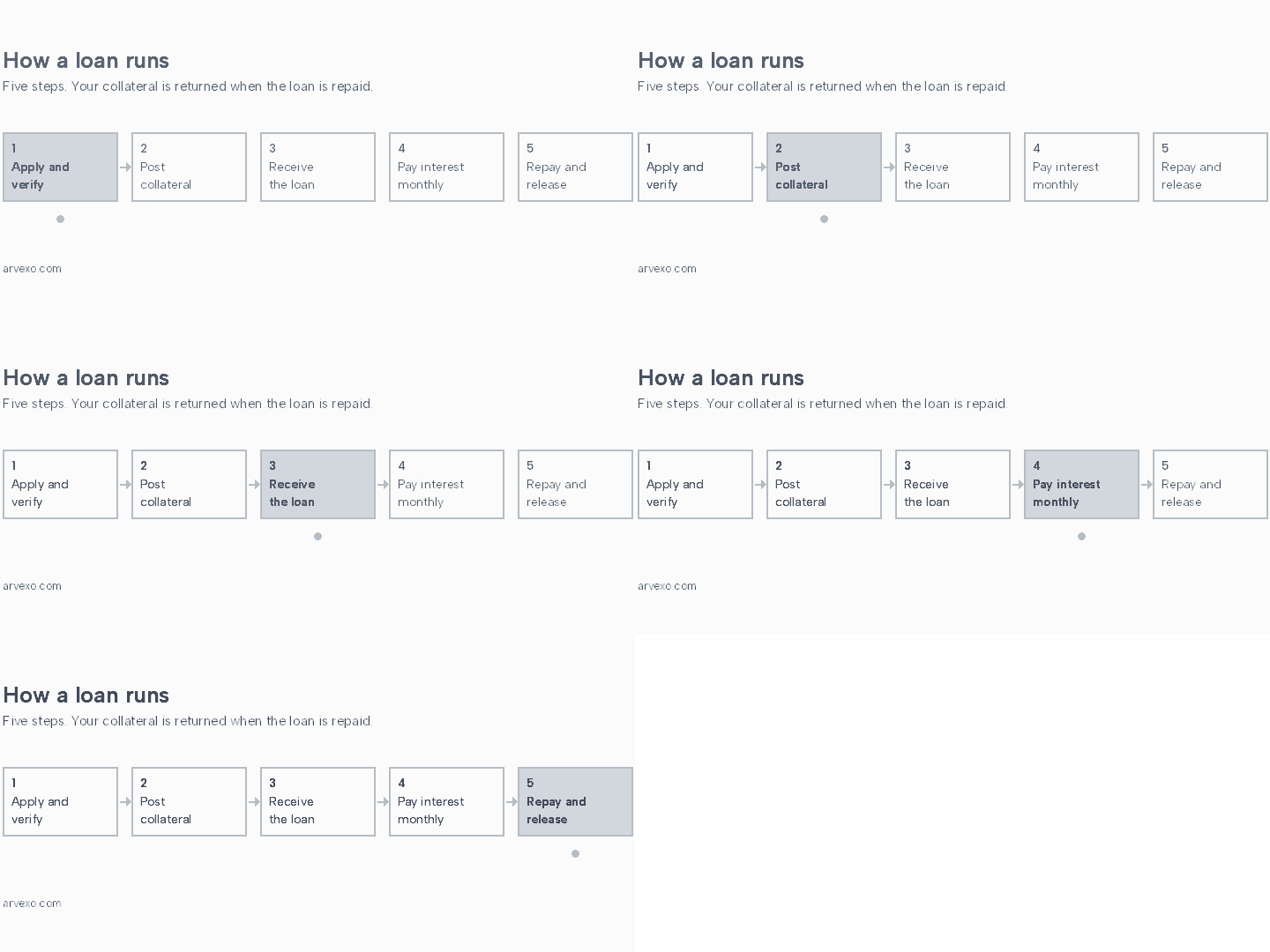
Apply and verify. Identity verification is required. There is no credit check, because the loan is secured by the collateral rather than by your credit history.
Post your Bitcoin. Collateral is transferred to the custody arrangement described below and held for the term of the loan.
Receive the loan in US dollars or USDC.
Pay interest monthly, with the principal due at maturity.
Repay and collect your Bitcoin. The same amount of BTC you posted, returned on repayment.
Where your Bitcoin sits
Collateral is held with institutional custodians, Ledger and Cobo Custody, in segregated wallets, and it is not lent out while your loan is open.
That last clause matters more than it reads. Re-using borrower collateral is what turned a falling market into a series of failures in 2022. If you are comparing lenders, ask each of them whether collateral can be lent, staked or otherwise re-used, and ask which clause of the agreement says so. How Arvexo holds collateral sets out the arrangement in full.
Rehypothecation, and why Bitcoin holders ask about it first
More than any other collateral, Bitcoin holders ask what happens to the coins while the loan runs. The question has a name: rehypothecation, meaning the re-use of collateral you posted.
A lender that re-uses collateral sends your Bitcoin out to earn a return while your loan is open. It is not inherently improper, and in traditional finance it happens under specific rules. In digital-asset lending it is the practice that turned a falling market into a chain of failures in 2022, because the coins were not there when people asked for them back.
Arvexo does not lend out collateral. It is held in segregated wallets with institutional custodians for the term of the loan and returned on repayment.
When you ask another lender this question, listen for which of two answers you get. “We don’t currently do that” describes a policy, and policies change under pressure. “We are contractually prohibited from doing that” is a promise, and you can ask which clause it lives in.
The risk, stated plainly
Bitcoin can fall a long way quickly. If your collateral falls far enough your loan-to-value ratio rises, we will ask for more collateral or partial repayment, and if it keeps falling the collateral is sold to repay the loan.
When a margin call is issued, the notice states how long you have to respond and the loan page shows the amount required.
At the maximum LTV a 12.5% fall is enough to trigger a margin call. Bitcoin has moved more than that inside a week on several occasions. Starting below the maximum is the only real defence, and it costs you nothing but collateral efficiency.
Margin calls and liquidation sets out exactly how far each asset has to fall and what you can do when the call arrives.
Collateral can fall in value and be sold. This page is for general informational purposes only and does not constitute financial, investment, legal, or tax advice.
Questions about Bitcoin loans
- Is there a credit check?
- No. The loan is secured against your Bitcoin, so approval does not depend on your credit history. Identity verification is still required.
- How much can I borrow against my Bitcoin?
- Up to 70% of its value at the start of the loan, with a minimum of $5,000 and no fixed upper limit. Larger facilities are reviewed individually.
- What happens if the Bitcoin price drops?
- Your LTV rises. At 80% we contact you to add collateral or repay part of the loan. At 85% collateral is sold to bring the loan back into line. Both thresholds are published above rather than buried in the agreement.
- Can my Bitcoin be lent out while the loan is open?
- No. Collateral is held in segregated wallets with institutional custodians and is not lent out.
- Do I get the same Bitcoin back?
- You receive the same amount of BTC you posted, returned on repayment of the loan.
- Is borrowing against Bitcoin a taxable event?
- A loan is not a sale, so posting collateral does not by itself realise a gain in the way selling does. But tax treatment depends on where you live, on the structure of the arrangement, and on what happens if collateral is ever sold. Borrowing against crypto vs selling works through the comparison for US and UK holders. Speak to a tax adviser before you decide.
Arvexo is not available in every country, and residents of some US states and Canadian provinces can visit the site but cannot use the service. Check availability before you apply.
Also available: Ethereum-backed loans · Solana-backed loans · All crypto-backed loans
Collateral can fall in value and be sold. This page is for general informational purposes only and does not constitute financial, investment, legal, or tax advice.