John Smith
 8 min read
How Crypto-Backed Loans Work
A crypto-backed loan lets you borrow cash against Bitcoin or other digital assets you already own, without selling them. This guide explains the steps, LTV, costs, margin calls, liquidation and who this kind of borrowing suits.

01 / Understand the basics
Borrow against the assets you already own.
What is a crypto-backed loan?
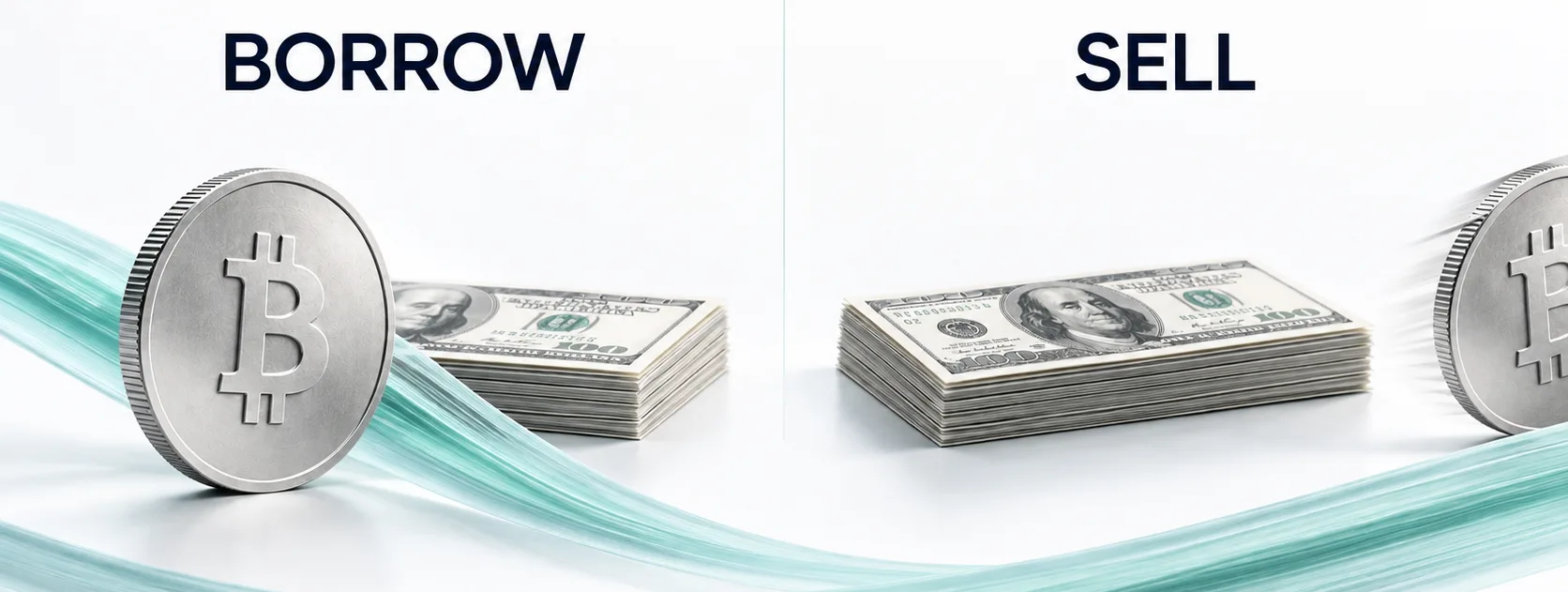
A crypto-backed loan is a secured loan. The security is your crypto. You keep your position in the asset while it sits in custody, so if the price rises during the loan, the gain is still yours. If the price falls, the loss is yours too, and the loan amount does not change.
That is the main difference from selling. Selling converts the asset to cash and ends your exposure. In the United States, the IRS treats a sale of virtual currency as a taxable event, so you must recognise any capital gain or loss when you sell (IRS, Q4). A loan is not a sale, but tax treatment depends on where you live and your circumstances, so speak to a tax adviser before you decide.
At Arvexo, loans start at $5,000, run from 1 to 48 months, and accept BTC, ETH, SOL, BNB and HYPE as collateral, with a maximum loan-to-value of up to 70% depending on the asset.

How do crypto-backed loans work? The five steps
Every lender has its own process. This is how it works at Arvexo.
- Set your terms. Choose how much you want to borrow, for how long, and which asset you will post as collateral. The loan calculator shows the collateral needed and the estimated monthly interest before you apply.
- Submit your request. Create an account, verify your identity, and send the request. Arvexo reviews it and keeps you updated by email.
- Transfer collateral. Once the request is approved, you send the collateral to the custody address. Arvexo holds collateral with Ledger and Cobo Custody in segregated wallets, and it is not lent out (see security).
- Receive your funds. When the deposit is confirmed, the loan is paid to the account you chose.
- Manage, repay and release. You follow your LTV in the dashboard, pay interest monthly, and repay the loan. When it is repaid in full, the collateral is returned to you.
02 / Understand your exposure
Loan-to-value (LTV), explained in one minute
LTV is the loan amount divided by the market value of the collateral.
Loan $50,000 ÷ Collateral value $100,000 = Loan-to-value 50%
Two LTV numbers matter. The starting LTV is the one you choose when you set your terms. The maximum LTV is the highest the lender allows for that asset at the start of the loan. At Arvexo the maximum is 70% for BTC, 65% for ETH, 60% for SOL, and 55% for BNB and HYPE.
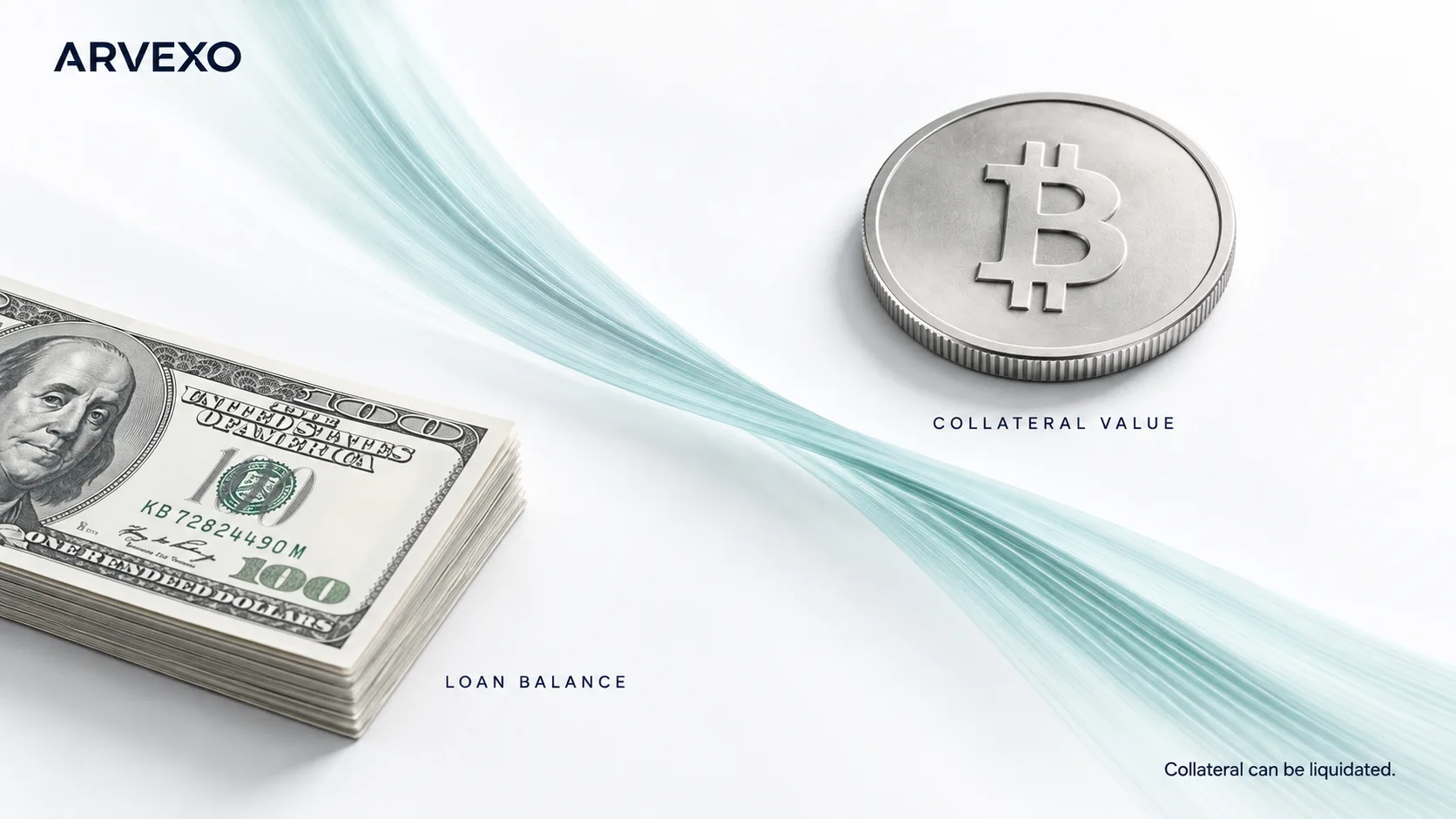
The loan amount is fixed, but the collateral value moves with the market, so your LTV moves every day. A lower starting LTV gives you more room before a price fall becomes a problem. The full formula and three worked cases are in What is loan-to-value?
Margin calls and liquidation
A margin call is a request from the lender to add collateral or repay part of the loan because your LTV has risen to a set threshold. At Arvexo the margin-call threshold is 80% LTV for BTC, 75% for ETH, 72% for SOL and 68% for BNB and HYPE, and the platform notifies you before the threshold is reached.
Liquidation is what happens if the LTV keeps rising past the liquidation level: 85% for BTC, 82% for ETH, 80% for SOL and 78% for BNB and HYPE. The lender sells enough collateral to bring the loan back within its limits or to repay it. You lose that part of your collateral, and the sale happens at a low point in the market.
| Asset | Maximum starting LTV | Margin call | Liquidation |
|---|---|---|---|
| BTC | 70% | 80% | 85% |
| ETH | 65% | 75% | 82% |
| SOL | 60% | 72% | 80% |
| BNB | 55% | 68% | 78% |
| HYPE | 55% | 68% | 78% |
How to respond to a margin call, and how to avoid one, is covered in Margin calls and liquidation: what every borrower should know.
03 / Know the commitment
What a crypto-backed loan costs
Interest starts from a 12.5% annual interest rate. The one-off origination fee is 1% of the loan, deducted from principal.
There are two costs to check before you borrow.
Interest. Arvexo loans start from a 12.5% annual interest rate. Interest is paid monthly. On a $50,000 loan at a 12.5% annual interest rate that is $513.70 for a 30-day month, or about $6,250 over a full year.
Origination fee. A one-off fee of 1% of the loan amount, deducted when the loan is paid out, so $500 on a $50,000 loan. The borrower receives $49,500. The debt is still the $50,000 principal.
Also allow for the network fee when you transfer collateral, and read the early repayment terms before you sign. Arvexo's are in Can I repay my loan early?
The main risks
Price falls. The UK's Financial Conduct Authority puts it plainly, writing that cryptoassets tend to be very volatile, so it's hard to pinpoint their value from one day to the next (FCA, Crypto: The basics). A sharp fall can take you from a comfortable LTV to a margin call in days. If you cannot add collateral or repay, part of your collateral is sold.
Lender and custody risk. Your collateral sits with the lender for the whole term. Ask who the custodian is, whether your collateral is held separately from the lender's own assets, and whether it is lent out or re-used. Crypto lending is lightly regulated in most countries and compensation schemes usually do not apply, so the lender's custody model is your main protection.
Missed payments. Interest is due every month. A missed payment can lead to penalties or liquidation, depending on the terms.
Eligibility. Crypto-backed loans are not available everywhere. Arvexo blocks sanctioned countries, and residents of some US states and Canadian provinces can visit the site but cannot use the service. Check Is Arvexo available in my country? before you apply.
04 / Follow the numbers
A worked example: from estimate to repayment
Illustrative example. The Bitcoin price used here is a round number, not a market quote, and the figures use Arvexo's current terms.
| Step | What happens | Numbers |
|---|---|---|
| Estimate | BTC at $100,000. Borrower wants $50,000 for 12 months and chooses 50% LTV | Collateral needed: 1 BTC ($100,000) |
| Fee | Origination fee of 1%, deducted at drawdown | $500, so $49,500 is paid out |
| Month 1 to 12 | Interest at a 12.5% annual interest rate, paid monthly | $513.70 per 30-day month |
| If BTC falls to $62,500 | LTV reaches 80%, the margin-call level for BTC | Add collateral or repay part of the loan |
| If BTC falls to $58,824 | LTV reaches 85%, the liquidation level | Collateral is sold to cover the loan |
| If BTC rises to $125,000 | LTV drops to 40% | Nothing to do |
| Month 12 | Repay the $50,000 principal with the final month's interest | Collateral returned: 1 BTC |
Over the year the borrower pays about $6,250 in interest and a $500 fee, keeps the Bitcoin, and never sells.
Same loan. Different room for a price fall.
| Starting LTV | Price fall before margin call |
|---|---|
| 50% | 37.5% |
| 70% | 12.5% |
BTC price fall before the 80% margin-call threshold. Illustrative example.
Compare the same $50,000 at the maximum 70% LTV. It needs only 0.7143 BTC of collateral ($71,428.57), but the margin-call price is $87,500, a fall of 12.5%, and the liquidation price is $82,353, a fall of 17.6%. At 50% LTV the same margin call needs a 37.5% fall. The lower starting LTV costs more collateral up front and buys a much wider safety margin.

05 / Make an informed decision
Who a crypto-backed loan suits
It suits a holder who wants to keep the asset for the long term, needs cash for a defined purpose, has a plan to repay, and can add collateral if the market drops. Borrowing well below the maximum LTV keeps the risk of a margin call low.
It does not suit someone who would be in trouble if the collateral were sold at a bad price, who cannot cover monthly interest from other income, or who wants to borrow in order to buy more crypto. That last case stacks price risk on top of price risk.
Before you apply
- Know why you are borrowing and how you will repay.
- Choose a starting LTV well below the maximum.
- Write down the margin-call and liquidation prices for your loan.
- Confirm who holds the collateral and whether it is segregated.
- Read the interest rate, fees and early repayment terms.
- Check that the service is available where you live.
Ready to see your own numbers? Estimate a loan in the calculator.
Collateral can fall in value and be sold. This article is for general informational purposes only and does not constitute financial, investment, legal, or tax advice.
Sources
- Internal Revenue Service, Frequently asked questions on virtual currency transactions, Q4, updated 30 June 2026.
- Financial Conduct Authority, Crypto: The basics.
- Arvexo, How it works, Security, Loan calculator.