Solana-Backed Loans
You can borrow US dollars against SOL without selling it. Whether you should, and whether a lender or an on-chain protocol suits you better, depends on three things most pages skip: how much room SOL's volatility leaves you, whether your SOL is staked, and how much you value not managing the position yourself.
This page answers all three, and you can start a loan at the end if it suits you.
What Arvexo lends against SOL
| Maximum starting loan-to-value (LTV) | 60% |
|---|---|
| Margin call at | 72% LTV |
| Liquidation at | 80% LTV |
| Interest rate (annual) | 12.5%, paid monthly |
| Origination fee | 1% of the loan amount, deducted at drawdown |
| Minimum loan | $5,000 |
| Terms available | 1 to 48 months |
| Loan currency | US dollars or USDC |
Why the SOL ceiling is the lowest of the three
Solana’s ceiling sits below Ethereum’s, which sits below Bitcoin’s. The ordering follows market depth, because the ceiling exists to protect a forced sale, and a forced sale in a thin market moves the price against you.
You can see the same judgement being made across the market. Coinbase publishes its own borrowing limits and caps Solana at $100,000, against $1,000,000 for Ethereum and $5,000,000 for Bitcoin, a fiftieth of the Bitcoin limit, with SOL grouped alongside Cardano, XRP and Litecoin. That is a product decision by the largest player in the market, published on their own page, and it tells you how the industry sizes the risk.
None of this is a judgement on Solana as a network. It is a statement about how much of a position can be sold in a hurry.
What that means for your loan
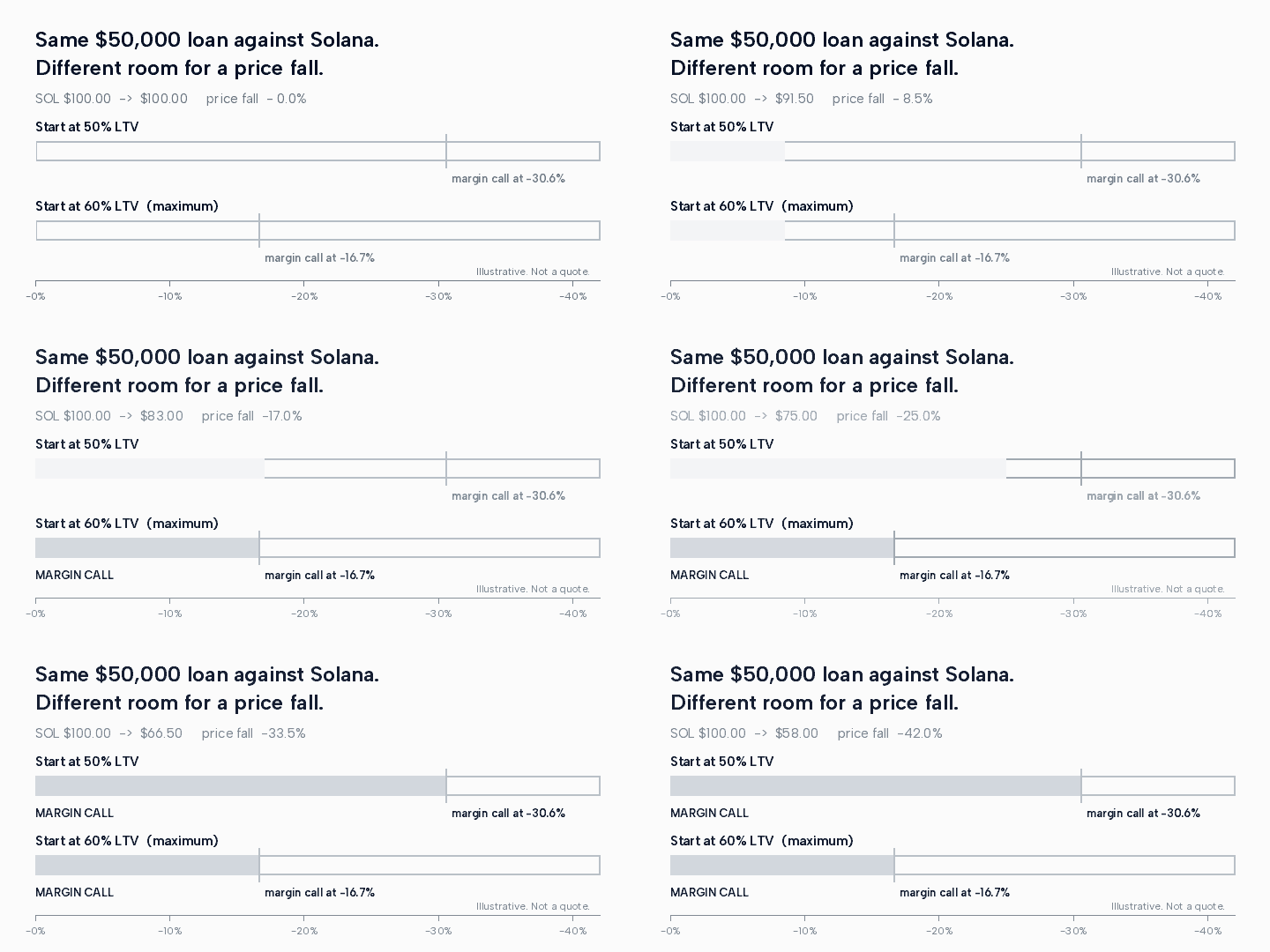
Illustrative. A round $100 SOL price is used for clarity, not as a market quote.
At the 60% maximum, a $50,000 loan needs 833.3333 SOL. Your margin call lands at $83.33, a fall of 16.7%. Liquidation at $75, a fall of 25%.
At 50%, the same loan needs 1,000 SOL, and the margin call moves down to $69.44, a fall of 30.6%.
The good news, relative to the other two assets: SOL’s lower ceiling means you start with more room at the maximum, not less. A Bitcoin loan at its maximum absorbs 12.5%; a Solana loan at its maximum absorbs 16.7%. The ceiling is lower because the asset moves more, and the two roughly cancel.
Can you still stake SOL used as collateral?
This is the question that separates Solana from every other asset on this list, because a large share of SOL is staked and the yield is not trivial. Giving it up for the term of a loan is a real cost that belongs in your arithmetic.
Whatever the answer, price it. If you are giving up staking yield for a year to hold a loan, that yield is part of the cost of borrowing, just as much as the interest.
Lender or DeFi protocol?
If you hold SOL you have a genuine choice that Bitcoin holders mostly do not: Kamino, Solend, Marginfi and Jupiter Lend will all lend against SOL on-chain. They work differently, and neither option is simply better.
On-chain protocols are permissionless, usually available immediately, and transparent. You can read the contract and watch the positions. Liquidation is automatic and unsentimental: a smart contract sells your collateral the moment the threshold is crossed, at any hour, with no notice, no conversation and no human discretion. You keep custody in the sense that no company holds your keys, and you carry smart-contract risk instead.
A centralised lender gives you a margin call with a notice window and a person to contact, fixed terms agreed upfront, and fiat you can actually spend. In exchange you hand over custody and take on counterparty risk, the risk that the company fails, which is not theoretical, as 2022 demonstrated.
The honest summary: a protocol is better if you want speed, permissionless access and no counterparty; a lender is better if you want notice before a liquidation, a fixed rate, and dollars in a bank account. The Financial Stability Board has observed that in decentralised finance, collateral “may be forcibly liquidated into a market with low liquidity”, and that the orderly-liquidation mechanisms and circuit breakers that exist in traditional markets are absent. Neither model removes the risk; they place it differently.
What you should check before borrowing against SOL
Whether you can top up quickly. With a 16.7% buffer at the maximum, the gap between a margin call and a liquidation is measured in hours, not weeks.
Where your collateral is held, whether it is segregated, and whether it can be lent out. Arvexo holds collateral with institutional custodians, Ledger and Cobo Custody, in segregated wallets, and does not lend it out.
What a forced sale would cost you beyond the collateral: if you borrowed to avoid selling, a liquidation is the outcome you were trying to prevent.
The staking question above, answered in writing before you transfer anything.
Margin calls and liquidation has the full checklist of what to confirm before you borrow.
Collateral can fall in value and be sold. This page is for general informational purposes only and does not constitute financial, investment, legal, or tax advice.
Questions about Solana loans
- How much can I borrow against my SOL?
- Up to 60% of its value at the start, minimum $5,000. Larger facilities are reviewed individually.
- Why is the Solana ratio lower than Bitcoin’s?
- Market depth, not quality. The ceiling protects a forced sale, and a large position in a thinner market is harder to sell without moving the price.
- Is borrowing against SOL riskier than borrowing against BTC?
- At the same starting ratio, yes, because SOL moves more. At each asset’s own maximum the difference largely cancels: a Solana loan absorbs a 16.7% fall before a margin call, a Bitcoin loan 12.5%.
- Do I keep ownership of my SOL during the loan?
- The collateral remains yours and the same amount is returned on repayment, unless it is sold to repay the loan following a liquidation.
Arvexo is not available in every country, and residents of some US states and Canadian provinces can visit the site but cannot use the service. Check availability before you apply.
Also available: Bitcoin-backed loans · Ethereum-backed loans · All crypto-backed loans
Collateral can fall in value and be sold. This page is for general informational purposes only and does not constitute financial, investment, legal, or tax advice.